A Reflection on New Zealand's Opposition to the Abuse of the UN Veto
The Case for a Stronger Voice for Smaller Nations at the Security Council
3 August 2026
The postwar idea of a fixed hierarchy of "great powers" doesn't match today's world. Countries once seen as peripheral now shape the global economy and international diplomacy. Their 1945 standing never anticipated this. That raises a fair question: do the original great powers still merit that designation, and is the system built around them nearly eighty years ago still fit for purpose?
At the centre of that question sits the UN Security Council, especially its veto system. This rule lets any one of five permanent members single-handedly block a decision, no matter how much support it has elsewhere. This piece traces New Zealand's opposition to that veto from the UN's founding in 1945 to today. It looks at a warning from a former New Zealand Prime Minister that still holds up. It considers how the balance of global power has shifted since then. It also explains why New Zealand believes smaller states deserve a stronger voice in the organisation's future, including through a seat of its own on the Council.
A Founding Objection
When the UN was established in 1945, the great powers of the day made the veto a condition of their membership. Their reasoning drew directly on the failure of the League of Nations, whose biggest weakness had been that several major powers simply weren't part of it. This time, the major powers weren't taking that risk.
New Zealand didn't accept this without a fight. Our delegation campaigned against giving any state that kind of unilateral power and joined several other smaller countries in abstaining from the vote that ultimately created it anyway. The veto, once adopted, allowed any one of five permanent members to block a resolution outright, regardless of how much support it had from everyone else.
That structure still defines the Council today. It has 15 members: five permanent (the P5), holding the veto, and ten elected by the General Assembly for two-year terms, together responsible for maintaining international peace and security. New Zealand's early objection didn't change the outcome, but it placed smaller states' concerns on the record from day one. The five original great powers, the United States, the Soviet Union (now Russia), France, the United Kingdom, and China, have held the veto ever since.
A Consistent Position
New Zealand's position hasn't moved since 1945. We've consistently opposed extending veto rights to any new Council members and have repeatedly called for reform that reflects today's political and economic realities rather than the balance of power that existed at the UN's founding. This isn't a new stance; New Zealand has served on the Security Council four times (1954–55, 1966, 1993–94, and 2015–16) and made the same argument each time.
That position was reaffirmed in September 2024, when Foreign Minister Winston Peters told the UN General Assembly that permanent members were abusing the veto, arguing that genuine multilateral cooperation means meeting one's obligations, not reaching for a veto whenever it's convenient. At the same address, he confirmed that New Zealand will campaign for a Security Council seat for the 2039–2040 term, signalling a long-term commitment rather than a one-off complaint.
Fraser's Warning, Still Relevant
Peters was deliberately echoing something New Zealand Prime Minister Peter Fraser said back in 1946: that a veto held by a single great power, usable against itself or against others, was fundamentally unfair, and that if left unchecked, it risked damaging not just the UN's purpose but the institution itself.
Nearly 80 years on, that warning reads less like caution and more like an accurate prediction. Peters described the spirit behind the UN Charter as wearing thin under the weight of its own history, strained by shifting power dynamics that have, at times, tipped into outright misuse of the veto. That matters to every UN member, New Zealand included, because it determines how much any country can actually rely on the Council to act. Some permanent members use the veto with restraint. Others don't.
Russia's conduct is the clearest recent example. After invading Ukraine, it used its own veto to block a Security Council resolution condemning that same invasion and calling for its troops to withdraw, effectively vetoing judgment on its own actions. Fraser anticipated exactly this kind of self-interested use of the power in 1946, warning it would be "very bad if one nation can hold up the advancement of mankind."
A Changed International Order
The global landscape in 2026 looks nothing like it did in 1945, and the institutions built back then haven't kept pace. The great powers recognised today, China, France, Germany, Italy, Japan, Russia, the United Kingdom, and the United States, now sit alongside a group of rising states carrying real weight of their own. India is widely seen as the country most likely to formally reach great-power status in the near future, and Turkey, South Korea, and Brazil are accumulating the kind of economic and diplomatic influence the postwar framework never accounted for.
Qatar is a particularly clear example of this shift. It's a small state with no permanent Security Council seat and a population smaller than many cities, yet it has become one of the world's most consequential diplomatic mediators, including brokering the 2020 agreement between the US and the Taliban, coordinating the 2021 Kabul evacuation effort. None of that influence comes from military strength or a formal seat at the UN table. It comes from sustained diplomatic investment and strategic positioning. If a country the size of Qatar can shape outcomes at that level, then the idea that global influence belongs only to the original great powers no longer holds.
Why This Matters for Smaller Nations
New Zealand's long-standing opposition to unchecked veto power isn't just symbolic. It reflects something we've believed since 1945: a state's military size shouldn't determine how much weight its voice carries on matters of international peace and security. A seat on the Security Council would give a smaller country like New Zealand a formal platform to make that case directly, rather than from the margins of the debate.
Reforming the veto system won't be easy; it would require the P5 to agree to give up the exact power that makes their seats so influential. But New Zealand's consistency on this issue, from its founding objection in 1945 through to its declared campaign for 2039–2040, reflects a coherent, long-held position. Smaller states aren't asking for charity. They're asking for a system that reflects the world as it actually is, not as it was drawn up eighty years ago.

The self-interested use of power could be very bad if one nation can hold up the advancement of mankind- Fraser 1946
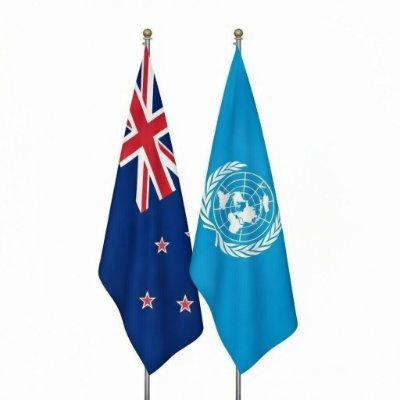
The National Flag of New Zealand and the Flag of The United Nations