
Who Could Become the Next United Nations Secretary-General and What is at Stake? - How the Process Works (Part 3)
How the Process Works (Part 3)
30 September 2026
What happens next and what are the qualities required in the next UN Secretary General?
In the third part of our blog, we describe the process going forward with the interactive dialogues having all taken place as well as the town hall and with all the focus now being firmly on the straw polls. The UN Security Council is expected to conduct several more rounds of straw polls to determine the candidate it will recommend to the General Assembly for approval of the selected candidate. The General Assembly approval which in the past has often been treated as a formality, is proving to be less so this time with some countries arguing that they need to have more say in terms of who should be the next UN Secretary-General.
The view that it is time for a woman to serve as the next UN Secretary-General
There has been considerable talk that it is time for a woman to serve as United Nations Secretary-General, something that has never happened before. Back in 2015 and 2016, there was similar talk of the need for a woman to become the next UN Secretary-General in a race which included former New Zealand Prime Minister Helen Clark. In 2017, the UN Security Council ended up selecting a man, António Guterres. It will be interesting to see if this time is any different. There is also an expectation, but not an obligation, that the next UN Secretary-General will come from the Latin American and Caribbean region. But these expectations are not obligations, and in the end it is the UN Security Council that will decide which candidate to recommend and the UN General Assembly that will endorse this candidate.
In the history of the United Nations, there has never been a candidate chosen by the UN Security Council whom the UN General Assembly has failed to confirm. This does not mean, however, that it could not in theory happen. Historically, the UN Security Council has only forwarded one candidate to the General Assembly, which then voted on a resolution to formalize the appointment. A simple majority vote from the 193 member states is required, on the basis of one nation, one vote. The major challenge in appointing a new UN Secretary-General is therefore to achieve UN Security Council endorsement without a candidate being vetoed, with the UN General Assembly appointment historically being seen as more of a formality.
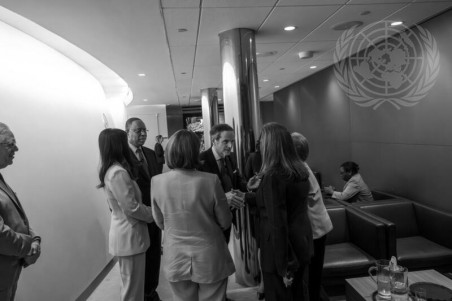
Candidates in conversation before entering the General Assembly Hall for the debate.

UN Security Council Secret straw polls
At the same time as the interactive dialogues, the UN Security Council has been conducting secret straw poll deliberations to try to achieve consensus on who they believe the next Secretary-General will be. These secret straw polls are not so secret, as the results have been leaked to the media.
What we know is that there is no consensus candidate yet and the favourites have been changing. What the straw polls tell us is that candidates with only 1, 2 or 3 "encourage" votes are very unlikely to win. What they don't tell us is who is for sure going to win. However, the straw polls do indicate that the winner is likely to be one of the candidates with a higher number of "encourage" votes, which reveals a strong likelihood of winning. Back in 2017, current UN Secretary-General António Guterres led from start to finish in the straw polls and he ended up being selected as the next UN Secretary-General. This time around, the race to be the next UN Secretary-General is much tighter.
The UN Security Council conducted its first informal straw poll on 30 July 2026. Each of the 15 Council members votes "encourage," "discourage," or "no opinion" for each candidate. At this stage, the votes of the Permanent Five veto-holding members are not differentiated from those of elected members. The results were leaked to the media. In the first poll (30 July 2026), Rebeca Grynspan received the highest number of "encourage" votes (10), followed by Carolyn Rodrigues Birkett (9) and Rafael Grossi (7). At that stage, these three candidates were the favourites.
The second straw poll took place on 21 August 2026. The results, as tabulated by 1 for 8 Billion, showed a significant shift, with Carolyn Rodrigues Birkett emerging as the new frontrunner with eight "encourage" votes, closely followed by Grynspan and Grossi with seven each. Olara Otunnu and Rodrigues Birkett showed the biggest gains from the first poll, while Michelle Bachelet slipped to seventh place with only two "encourage" votes.
The third straw poll, reported on 18 September 2026, returned Rebeca Grynspan to the top of the field with nine "encourage" votes, five "discourage" and one "no opinion", though it is unclear whether she can overcome a veto by one of the permanent five members of the Security Council. Carolyn Rodrigues Birkett was close behind with eight "encourage" votes, followed by Rafael Grossi, Olara Otunnu and Macky Sall on five each. Grossi, Otunnu and Sall each drew more "discourage" votes than either of the top two, while María Fernanda Espinosa received three "encourage" votes, Michelle Bachelet one and Ivonne Baki none.
Grynspan and Rodrigues Birkett now clearly lead, while Grossi has fallen back from the first-round pack. Grossi, Otunnu and Sall are tied on five "encourage" votes, but each attracted more "discourage" votes than either of the top two. The straw polls do not yet distinguish the votes of the Permanent Five from those of elected members, so it is impossible to say whether any leading candidate faces a veto.
Grynspan had led the field after the first round, was overtaken in the second round, and has now moved back to the top. There remains considerable frustration among the wider UN membership that no similar deliberative process exists for the General Assembly, which in the past has generally been seen as a rubber stamp for the selection made by the Security Council.
Bachelet withdraws: Michelle Bachelet has withdrawn from the race.
As the secret straw polls and Security Council deliberations are ongoing, a preferred candidate is likely to emerge shortly, with the official confirmation vote of the UN General Assembly expected to happen before the end of the year.
Why is it important to have such a strong leader who can build consensus and mediate existing conflicts?
UN and international law is increasingly being flouted by multiple countries. It is therefore absolutely essential to have a new strong leader who can help improve the ability of the UN to prevent and mediate conflicts and can make the United Nations a more effective preserver of peace, human rights, and sustainable development.
The next UN Secretary-General will face enormous challenges in reforming the UN and in restoring the standing of the UN. The moral authority of the UN has been reduced in recent years due to its increased inability to prevent or mediate the increased number of conflicts in the world. Media articles have helped raise awareness of the bloated bureaucracy of the UN, duplication of work and a lack of results in areas such as sustainable development and human rights. Corruption scandals and a repeated failure over many years of the UN to protect whistleblowers have shown that the UN needs to significantly improve its governance framework.
Some critics say that the United Nations, formed in the aftermath of World War II, is currently not fit for purpose and that the world today is a very different place from the world of 1945. The UN has not been able to prevent or end the majority of conflicts around the world. They argue that the cost cutting currently underway under the UN80 process is not making the UN a better and more effective organisation. However, others argue that the alternative of having nothing is even worse and even more unlikely to be able to prevent conflicts from arising or being settled. Where states are around a table and talking, there is always hope.
The successor to UN Secretary-General António Guterres will face the challenge of revitalising an organisation that is experiencing the biggest crisis and decline in its standing since its formation in 1945.
Conclusion: The United Nations Requires a Strong Leader
We believe that a strong leader is a pre-requisite for the next UN Secretary-General, and this means an individual who can stand up to great powers when necessary. At the same time, it is important that the next UN Secretary-General has the respect of all members of the UN Security Council. Such an individual should be able to put their ego to one side, serve as a neutral broker and consensus builder, without bias, and use diplomatic skill to prevent future conflicts while also being a leader who can help effectively mediate existing and ongoing conflicts.
The new leader of the UN should use the tools at the Secretary-General's disposal, including moral leadership and the principles enshrined in the UN Charter such as consensus building, good offices and mediation, to take a more pro-active approach and aim to de-escalate situations before conflicts erupt. As Carolyn Rodrigues Birkett said: "Conflicts do not start in a day. There are signals before a conflict erupts". The next Secretary-General must be proactive and pragmatic in identifying opportunities to intervene before conflicts escalate, and must work to "move the needle" on the world's most protracted conflicts.
We believe that a strong UN leader must understand that UN reform and the UN80 process are much more than just about cost cutting. They are also about a renewed and reformed UN that is much more results-oriented, with greater effectiveness and efficiency. We believe that independence is important, meaning that Member States need to understand that an organisation that evaluates and audits itself, and has an internal justice system that reports to management, cannot achieve optimal results. We believe that the UN requires a stronger governance framework, with greater transparency and accountability, which listens and takes note, and when external evaluations conclude mistakes have been made, action must be taken.
A strong UN leader must also understand that the HR system that the UN introduced in 1945 is not the HR system fit for the world in 2026. The HR system of the UN needs complete reform. One of the reasons that the UN is not as effective as it could be, especially in the area of development assistance, is that the HR system does not reward energy, innovativeness, risk taking, or an entrepreneurial approach.
We believe that a strong leader at the United Nations must understand that taking the moral high ground enshrined in the UN Charter is a precursor for achieving consensus, and that dialogue and real engagement, including face to face meetings with relevant senior officials and leaders, are critical. A UN leader who is highly respected by all member states is more likely to achieve strong results than someone who is controversial and not respected by some. It is absolutely essential not to become cynical and for the UN Secretary-General to practice what he or she preaches, and to not selectively call out breaches of international law. It is important to be consistent.
Finally, we believe that a strong leader at the United Nations should also understand that real reform at the UN is long overdue and urgent, and that an effective United Nations Secretary-General will need to be much more General and much less Secretary.
____________________
The views expressed in this article are those of the authors and do not necessarily represent the official position of the United Nations Association of New Zealand.
About the Authors
John O’Brien has been serving as Special Officer for UN Reform of the United Nations Association of New Zealand since 2022. Prior to this, he worked for 12 1/2 years for the United Nations Development Programme (UNDP) in Europe as a Regional Technical Advisor on Climate Change mitigation based out of Bratislava and Istanbul. Since he returned to New Zealand in April 2022, he has been running his own climate change brokerage and trading company, based out of Wellington. John holds a Masters in International Affairs from Columbia University in New York focused on international environmental policy.
Mia Heaphy is a Policy Advisor working across health and social policy in Aotearoa, with a focus on equity and community wellbeing, and is currently a Media and Communications Intern with UNA NZ. She holds a Master of Peace and Conflict Studies (Distinction) from the University of Otago, along with academic training in politics, criminology, and education. Her work draws on experience in kaupapa Māori and community-led approaches, and she brings a strong interest in international development and humanitarian response.
Who Could Become the Next United Nations Secretary-General and What is at Stake? - How the Process Works