
Who Could Become the Next United Nations Secretary-General and What is at Stake? Part Two
Who are the Candidates - Favourites, Dark Horses, and Longshots (Part II)
23 September 2026
The second part of our blog provides a run down on each of the the 8 declared candidates for UN Secretary-General and outlines issues around each one, making the case for why they are a favourite, a dark horse, or a long shot. We then go on to explain why the appointment of a strong leader for the United Nations is so important and what is at stake. While the UN Secretary-General cannot compel member states to act in a certain way, meaning that power is somewhat limited, the role can provide moral leadership and play a strong role in consensus building towards ending conflict and conflict prevention and to a humanitarian and development system that works more effectively.
Officially Declared Nominations
There is no hard fixed deadline or strict cutoff date in the UN Charter to nominate a candidate for UN Secretary-General, though the UN initially set a target date of April 1, 2026, for the ongoing 2026 selection cycle. However, four candidates (Espinosa, Rodriguez-Birkett, Baki, and Otunnu) were all nominated after this deadline showing clearly that there is no hard and fast rule and no fixed mandatory deadline to be nominated. The nomination has led to some squabbling among member states over concerns that a last minute candidate entering the race and not needing to go through the town hall, interactive dialogues or straw poll process could be unfairly advantageous.
The official candidates for the next UN Secretary-General currently consists of a field of 7 declared candidates, as of 23rd September 2026.
Michelle Bachelet (Chile) - Withdrawn, 19 September 2026. Nominated by Chile, Brazil and Mexico on 2 February 2026, Bachelet was a former two-term President of Chile and former UN High Commissioner for Human Rights, and campaigned on defending multilateralism and international law. Her candidacy struggled to gain traction among Security Council members, and she faced criticism over her human rights record, particularly regarding China and the Uyghurs. Chile also withdrew its nomination after a shift to a right-wing government. After the third straw poll showed her support had all but collapsed, she announced she would continue her international work outside the race.
Rafael Grossi (Argentina) - Nominated by Argentina on 26th November 2025. Grossi has been a high-profile Director General of the International Atomic Energy Agency (IAEA) for the past six years. His role as Director General has seen him prioritizing strict arms control, non-proliferation, and operational accountability. Many diplomats consider him a frontrunner after his years of relations with the five permanent members, whose backing is crucial for this role. Russia has publicly expressed reservations, accusing him of bias in his nuclear monitoring reports. We believe that the United Kingdom as a P5 member may well have reservations over Grossi due to the fact that Grossi is an Argentine national and the UK and Argentina have a long running dispute over the Falkland Islands. Nevertheless, Grossi is, in general, considered to be a favourite due to his UN system experience and strong relationship with the other members of the P5.
Macky Sall (Senegal) - Nominated by Burundi on 2 March 2026. Sall governed Senegal from 2012 to 2024 and brings presidential-level experience from a stable African democracy, making him a respected leader. Sall successfully brought the African Union into the G20 as a permanent member and mediated regional conflicts, notably in Gambia and the Casamance region. He is considered a dark horse due to competition from other African candidates. His candidacy has caused immense friction, with over 20 AU member states rejecting a unified African Union endorsement as some countries, including his home country Senegal, strongly oppose his candidature. Sall also faces strong criticism regarding alleged financial mismanagement, falsifying public data, and corruption during his final years in office as President of Senegal and the current government in Senegal is looking into prosecuting him and putting him on trial. This issue, which has been widely reported in numerous media outlets, makes him also a long shot to be selected as the next UN Secretary-General.
María Fernanda Espinosa (Ecuador) - Nominated by Antigua and Barbuda on 11th May 2026. A former President of the UN General Assembly and former foreign minister and defence minister of Ecuador, Espinosa has deep experience in multilateral diplomacy. Her platform focuses on creating a unified administrative organisation rather than multiple competing entities. However, her independent stance on avoiding regional and geopolitical blocs may make it difficult to secure unanimous approval from all P5. Espinosa stands out as a dark horse in this race, with her UNGA presidency giving her visibility, but she has the disadvantage that, like Bachelet, she has not been nominated by her own government. In addition, Espinosa, has previously served as a minister under Ecuador's former leftist President Rafael Correa (2007-2017) and has historical ties to regional leaders like Hugo Chávez and Fidel Castro which some have argued “raise serious concerns about her judgment and neutrality”. In particular, we believe that it is highly unlikely that the United States would support a candidate with such past associations.
Rebeca Grynspan (Costa Rica) - Nominated by Costa Rica on 3 March 2026. Grynspan was Costa Rica's former Vice President and she also formerly held senior positions in UNDP. Grynspan has led the UN Conference on Trade and Development (UNCTAD) since 2021, taking temporary leave from that post to campaign. She topped the first informal straw poll on 30 July with strong encouraging votes, though her support slipped in the second poll held in late August. Grynspan is a favourite, along with Grossi and Rodrigues Birkett, drawing on deep UN agency experience, technical credentials, and broad Latin American backing, though a growing bloc of discouraging votes has left her no longer the clear frontrunner. Grynspan is seen by some as the Guterres appointee which leads to a perception among some countries that she represents the status quo. The Watchdog Group UN Watch has argued that Grynspan has a lack of reform appeal and that her record suggests more continuity than change. Despite these concerns, we believe that Grynspan remains a favourite.
Ivonne Baki (Ecuador) - Nominated by Tonga on 17 August 2026. Born in Guayaquil to Lebanese parents, this Ecuadorian diplomat previously served as Ecuador's Minister of Foreign Trade and held ambassadorial posts including in Washington and Qatar, and has been credited with helping broker dialogue between Ecuador and Peru after their 1995 border conflict. Baki entered the race at the last minute and she is viewed as a long shot, entering the race as its eighth candidate with little time before straw polling advances to build the momentum needed to catch the frontrunners. In addition, because Baki formally entered the race very late, in mid-August 2026 it meant that this left virtually no time for UN Security Council members to become familiar with her or her specific multilateral vision. In addition, another disadvantage is that just like her compatriot, Espinosa, Baki failed to secure the backing of her home country, Ecuador.
Olara Otunnu (Uganda) - Nominated by Uganda on 24 July 2026. Otunnu is a former Ugandan diplomat who helped devise the informal straw-poll method now used to assess Secretary-General contenders nearly 45 years ago, Otunnu brings genuine UN institutional history to the race. Otunnu is a dark horse, with some observers viewing him as credible on the strength of his UN career, though his late entry and the political excess of sponsorship by the current Ugandan government complicate his path. The last UN Secretary-General from Africa was the legendary Kofi Annan. However, for an African candidate to succeed, they typically require unified backing from the African Union. The 2026 race is highly congested with two African political heavyweights, Sall and Otunnu, both entering the race, making it more difficult for both candidates.
Carolyn Rodrigues Birkett (Guyana) - Nominated by Guyana on 15 June 2026. A career diplomat and former politician, she has served as Guyana's Permanent Representative to the UN since 2020 and has pledged to act as a "neutral broker" when Security Council divisions block action. Rodrigues Birkett is one of the favourites, having overtaken the field to top the second informal straw poll in late August, making her the current frontrunner and putting her on track to become the UN's first woman and first Caribbean Secretary-General. Rodriguez Birkett ticks all three boxes of firstly being a woman, secondly being from the Latin America and Caribbean region and thirdly not having any controversies surrounding her candidature.
Mia Mottley (Barbados) - The previous heavily favored frontrunner for the UN Secretary-General position, Mia Mottley of Barbados chose to not officially enter the race as she decided to focus on her job as Prime Minister of Barbados, where she won a third term back in February 2026. Prior to this announcement, Mottley was widely seen as the favourite to become the next UN Secretary-General. Mottley is a very strong public speaker with persuasive delivery style at high-profile international gatherings, and this made her an early favourite in the race before she announced she would not officially be running.

Who will the winner be? Only time will show.
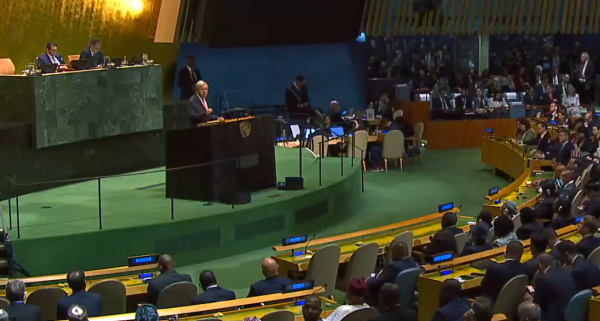
António Guterres, Secretary-General of the United Nations, addresses the General Debate of the 81st Session of the General Assembly of the UN.
22nd September 2026
With 7 candidates running and no fixed timetable for selection, it is not clear yet exactly when the decisions will be made and the winner selected. However, we do know that the next United Nations Secretary-General is expected to start their five year term (once renewable) on 1 January 2027.
The United States government has stated in public that, in the event that consensus is not reached in time, they would not like to see the term of current UN Secretary-General Guterres extended. The United States opposes any temporary or extended continuation of António Guterres past December 31, 2026, because the Trump administration wants a clean break to install a new leader who will prioritize state sovereignty, enforce strict institutional accountability, and redirect the UN back towards its core charter.
Who will the winner be? Only time will show.
____________________
The views expressed in this article are those of the authors and do not necessarily represent the official position of the United Nations Association of New Zealand.
About the Authors
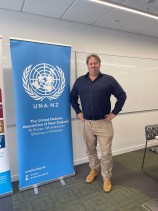
John O’Brien has been serving as Special Officer for UN Reform of the United Nations Association of New Zealand since 2022. Prior to this, he worked for 12 1/2 years for the United Nations Development Programme (UNDP) in Europe as a Regional Technical Advisor on Climate Change mitigation based out of Bratislava and Istanbul. Since he returned to New Zealand in April 2022, he has been running his own climate change brokerage and trading company, based out of Wellington. John holds a Masters in International Affairs from Columbia University in New York focused on international environmental policy.

Mia Heaphy is a Policy Advisor working across health and social policy in Aotearoa, with a focus on equity and community wellbeing, and is currently a Media and Communications Intern with UNA NZ. She holds a Master of Peace and Conflict Studies (Distinction) from the University of Otago, along with academic training in politics, criminology, and education. Her work draws on experience in kaupapa Māori and community-led approaches, and she brings a strong interest in international development and humanitarian response.
Image Taken from “UN Secretary-General Addresses General Debate, 81st Session” https://www.un.org/en/sg-selection-and-appointment