Who Could Become the Next United Nations Secretary-General and What is at Stake?
How the Process Works (Part I)
16 September 2026
The first part of our 3 part blog series looks at the process of choosing the next Secretary-General of the United Nations which is currently entering a decisive phase. Eight candidates have now been formally nominated to succeed António Guterres when his second term concludes on 31 December 2026. Each candidate must be nominated by at least one UN member state (each state may nominate only one candidate). The nominee does not need to be a citizen of the nominating country.
Who exactly is the UN Secretary-General and what do they do?
The United Nations Secretary-General acts as the chief administrative officer and top diplomat of the organisation, leading its global secretariat and steering its international agenda. Founded in 1945 at the end of World War 2, the international agenda of the UN has always been to aim to prevent the world from entering into more wars with the key phrase in the UN Charter being:
"We the peoples of the United Nations are determined to save succeeding generations from the scourge of war, which twice in our lifetime has brought untold sorrow to mankind..."
The United Secretary-General is the most important role in the entire United Nations system, leading an organisation with a budget including the UN Secretariat, separate funds and specialised agencies, of over $60 billion usd and with over 37,00 staff and charged with its main goal of promoting peace and security. The UN Secretary-General, under Article 99 of the UN Charter, has the power to bring any matter that threatens international peace or security that he or she sees fit to the attention of the UN Security Council. The United Nations also works to promote the Sustainable Development Goals (SDGs) which are a collection of 17 aspirational global goals designed to end poverty, protect the planet, and ensure peace and prosperity for all.
What is at Stake and the UN80 Reform Initiative
The next UN Secretary-General should be a leader with compassion who shows integrity, takes the moral high ground and has excellent communication and consensus building skills that will help enable the UN reform and become a more efficient and effective organisation, better equipped to deal with the challenges that the world is facing. The next UN Secretary-General will need to continue the UN80 Reform Initiative which began in 2025 (as the UN marked its 80th anniversary) under United Nations Secretary-General António Guterres with a goal to modernize, streamline, and make the organisation simpler, and more cost-effective and cohesive. UN80 Reform Initiative involves cutting red tape, sharing back-office services, and optimizing the UN's global footprint by moving functions to lower-cost duty stations. However, it is also supposed to involve increased efficiency and effectiveness, more transparency and reduce duplication as right now there are many UN agencies with overlapping mandates. It is worth noting that the UN80 process is very much a work in progress, and will not be finished under Guterres, so it will very much be a task for the new UN Secretary-General to take up and lead on this issue.
In addition, the new UN Secretary-General will need to help improve progress towards the highly ambitious 17 UN Sustainable Development Goals (poverty, hunger, health, gender, well being, clean water, clean energy etc.) is uneven. The UN faces real challenges with limited resources and a mostly grant based approach with limited funds, and with big difficulties in working effectively with the private sector to achieve these sustainable development goals.
It is important to note that the UN is only as strong as its member states. It does not have an army itself and it does not possess military forces of its own. The Security Council needs to authorise all uses of force and due to the veto power of the P5 (permanent 5), in an increasingly polarised world, this very rarely happens. This makes it even more challenging for the UN to be effective in the areas of conflict prevention and conflict mediation and therefore a UN leader who possesses excellent diplomatic skills is extremely important.

"We the peoples of the United Nations are determined to save succeeding generations from the scourge of war, which twice in our lifetime has brought untold sorrow to mankind..."
Interactive Dialogues for the Selection of the next UN Secretary-General
The interactive dialogues surrounding the selection of the next United Nations Secretary-General were convened by the UN General Assembly to help transform what was previously a highly secretive selection process which was previously completely controlled by the P5 (permanent 5) members of the UN Security Council. The first time that the dialogues were carried out was in 2016, when António Guterres was selected and appointed as UN Secretary-General, starting his term on 1 January 2017.
The 1 for 8 Billion campaign, initiated by the UK UN Association, (which launched as 1 for 7 billion back in 2014) seeks to add more transparency to the UN Secretary-General selection process. It is called 1 for 8 billion because in a world with a population of 8 Billion people, there is only 1 UN Secretary-General. The 1 for 8 Billion campaign sent a letter to the Presidents of the General Assembly and Security Council calling for all candidates to be subject to the same process, warning of the erosion of credibility and the risk of leaving the door open for possible future last-minute candidates for whom is is suggested may evade a similar level of scrutiny and accountability as the other nominated candidates.
The structure of the interactive dialogues has involved each candidate reading out a vision statement to the UN General Assembly as part of a formal presentation outlining their vision, priorities, and proposed goals for the future of the United Nations. Following the presentation, the candidates are available for direct questioning by member states. Each member state has an equal opportunity to question the candidates and every individual session is streamed live around the world on UN Web TV. Selected NGOs and civil society organisations are also given the chance to ask questions. The questions are structured around four main areas of importance for the UN.
Peace and Security
Sustainable Development
Human Rights
UN Institutional Reform (the UN80 process)
The initial wave of interactive dialogues took place between April and June of 2026 and are now finished. During these three-hour sessions, each candidate has presented a vision statement of up to 10 minutes, followed by questions from UN member states and civil society representatives on topics ranging from leadership abilities to the three pillars of the UN: peace and security, development, and human rights. The dialogues have been structured to allow member states and civil society to address the most pressing issues the UN faces, and every session has been broadcast live on UN Web TV.
Interactive Dialogues
The UN interactive dialogues for the next Secretary-General selection revealed competing candidate visions for addressing severe geopolitical strains, budget constraints, and the eroding trust in multilateral institutions. Different candidates focused on different issues in the interactive dialogues. For example, Michelle Bachelet proposed a focus on human rights and strongly defended human rights as a foundation for security and development and warned against a retreat from the acceptance and widespread use of international law to resolve disputes. Rebecca Grynspan focused on mediation and diplomacy while Rafael Grossi stressed the importance of moral authority in diplomacy and the need to always maintain the moral high ground. Together, these three candidates are currently viewed as the favourites and it is worth noting that none of them could be viewed as an “outsider” to the UN system.
In August 2026, Ugandan diplomat Olara Otunnu emphasised that the immediate priority must be given to the proliferation of increasingly deadly conflicts threatening to engulf entire regions, promising to support efforts to end the Ukraine crisis, address the Gaza crisis, and work with the African Union to end the conflict in Sudan. Ecuadorian diplomat Ivonne A-Baki struck a distinctive note, saying she wants to be a "leader rather than a manager…a manager is someone who follows a mission statement. A leader is someone who follows a north star", and she spoke of "renewal" rather than merely "reform" of the UN. Carolyn Rodrigues Birkett has outlined a pragmatic approach focused on preventive diplomacy, saying she would examine the history of individual conflicts and identify new pathways for resolution.
UN Town Hall Meeting with the Candidates
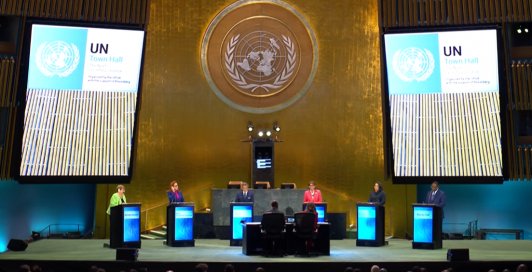
Candidates at UN Town Hall Meeting July 23, 2026
On 23 July 2026, a major "UN Town Hall: The Next Secretary-General" was held in the General Assembly Hall, marking an important milestone in the selection process. The town hall, organised by the Office of the President of the General Assembly with the support of Bloomberg, was moderated by journalists and featured a discussion with groups of candidates. Member states, civil society representatives, and UN staff were invited to participate. The event allowed candidates to reach a global audience and included an audience survey, reportedly a surprise to candidates and observers alike. In that town hall audience poll, Carolyn Rodrigues Birkett led with 49 votes, followed by Grynspan and Espinosa.
The results of both the interactive dialogues and the UN Town Hall meeting with the candidates were inconclusive. Based on an analysis of these two processes, it is very difficult to determine who the next UN Secretary-General will be. In the second part of our blog, we look at each of the candidates one by one before going on in Part 3 to look at what happens next, including discussing the straw poll process.
____________________
The views expressed in this article are those of the authors and do not necessarily represent the official position of the United Nations Association of New Zealand.
About the Authors
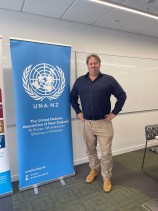
John O’Brien has been serving as Special Officer for UN Reform of the United Nations Association of New Zealand since 2022. Prior to this, he worked for 12 1/2 years for the United Nations Development Programme (UNDP) in Europe as a Regional Technical Advisor on Climate Change mitigation based out of Bratislava and Istanbul. Since he returned to New Zealand in April 2022, he has been running his own climate change brokerage and trading company, based out of Wellington. John holds a Masters in International Affairs from Columbia University in New York focused on international environmental policy.
Mia Heaphy is a Policy Advisor working across health and social policy in Aotearoa, with a focus on equity and community wellbeing, and is currently a Media and Communications Intern with UNA NZ. She holds a Master of Peace and Conflict Studies (Distinction) from the University of Otago, along with academic training in politics, criminology, and education. Her work draws on experience in kaupapa Māori and community-led approaches, and she brings a strong interest in international development and humanitarian response.