
World Humanitarian Day in Aotearoa
29 August 2026
Humanitarian action is often communicated through numbers: people displaced, funding required, supplies delivered and communities reached. Yet behind every figure is a person and behind every response are people choosing to act.
On 19 August, members of Aotearoa New Zealand’s humanitarian community gathered at Parliament to mark World Humanitarian Day. Organised by the Council for International Development, the event brought together organisations and individuals working across international development and humanitarian response.
Through an interactive exhibition and conversations across the sector, the gathering showcased humanitarian action taking place across the Pacific and around the world. It also created an important opportunity to recognise those undertaking this work, strengthen relationships and reflect on what effective humanitarian action requires today.
Reflecting on the purpose of the gathering, Sam London, Standards and Humanitarian Manager at the Council for International Development Aotearoa New Zealand, said:
"Humanitarianism globally is under enormous strain. Needs are growing, resources are stretched, and the principles that underpin humanitarian action are increasingly being challenged. From New Zealand, our size and geography can make these challenges feel distant and our role in responding to them easy to overlook. But New Zealand has an incredible community of humanitarians working all around the world. We wanted to bring that work into Parliament so our leaders could see it, take pride in it and recognise its value. At a time when countries are increasingly looking inward, principled humanitarian action is an important way for New Zealand to put our values into practice, help people in need and contribute to a safer and more stable world."
A day grounded in the United Nations
World Humanitarian Day is observed by the United Nations each year on 19 August. It honours the people who provide life-saving assistance to communities affected by conflict, disaster and displacement, while remembering humanitarian workers who have lost their lives in service.
The date commemorates the bombing of the United Nations headquarters at the Canal Hotel in Baghdad on 19 August 2003. The attack claimed the lives of 22 humanitarian workers, including the UN Special Representative of the Secretary-General for Iraq, Sérgio Vieira de Mello.
For United Nations Association of New Zealand member Pauline McKay, who was working with the World Health Organization in Geneva at the time, the attack was deeply personal. She knew several people who survived the bombing, including one colleague whose meeting had been moved from the affected room at the last minute. Some of her WHO colleagues drew on their medical training to care for the wounded, despite no longer working in clinical practice. Pauline recalls,
“It was such a shock for a UN office to be targeted in this way."
In response, staff from across the UN system marched through Geneva to mourn their colleagues and express their solidarity. The procession was led by the heads of UN agencies and UN drivers, acknowledging the particular vulnerability of personnel stationed outside UN offices. It was a powerful reminder that all those serving in conflict environments can be exposed to considerable risk.
Sérgio Vieira de Mello was later laid to rest in Geneva, reflecting the profound connection between the city and the international community he served.
Five years later, the United Nations General Assembly formally designated 19 August as World Humanitarian Day.
The day is one of remembrance, but its purpose extends further. It draws attention to the importance of protecting civilians and humanitarian personnel, upholding international humanitarian law and ensuring assistance can reach people experiencing crisis.
Humanitarian action is central to the work of the United Nations. When conflict escalates or disaster strikes, UN agencies work with governments, civil society, local organisations and humanitarian partners to coordinate assistance and help deliver food, clean water, healthcare, shelter, protection and other essential services.
These efforts are often highly visible during an emergency. However, the relationships, preparation and local knowledge that make an effective response possible are built over many years.
Humanitarian principles under pressure
World Humanitarian Day comes at a time when humanitarian needs remain immense, resources are under strain and those delivering assistance face significant risks.
International humanitarian law provides essential protections for civilians, medical personnel, humanitarian workers and civilian infrastructure during armed conflict. These protections are not abstract legal principles. They have a direct impact on whether assistance can reach the people who need it.
When humanitarian workers cannot operate safely, communities may lose access to food, medicine, shelter and essential services. Protecting humanitarian personnel is therefore inseparable from protecting the people they serve.
Respect for international humanitarian law must remain a shared priority. Governments, parties to conflict and the wider international community all have responsibilities to protect civilians, enable humanitarian access and ensure accountability when these protections are violated.
Humanitarian organisations also continue to work through increasingly complex circumstances. Conflict, forced displacement, food insecurity, public health emergencies and climate-related disasters frequently overlap, placing further pressure on communities and response systems.
The work requires courage, but it also requires sustained funding, careful coordination and strong partnerships.
The urgency of these challenges has been brought into stark focus by the devastating flash floods that struck Nepal on 26 August 2026. Communities have experienced loss of life, displacement and extensive damage to homes and essential infrastructure, while local authorities, United Nations agencies and humanitarian partners continue to mobilise assistance. The evolving emergency reinforces the importance of preparedness, coordinated action and locally led response.
A Pacific perspective
For Aotearoa New Zealand, humanitarian action has a particularly important Pacific dimension.
Our region is highly exposed to cyclones, earthquakes, volcanic activity and the growing effects of climate change. These events can disrupt homes, livelihoods, essential infrastructure, health services and education while placing additional pressure on communities that may already be managing economic and geographic challenges.
New Zealand has a longstanding role in supporting humanitarian preparedness and response across the Pacific. This contribution includes working with Pacific governments and communities, supporting national and international response organisations, deploying technical expertise, and providing financial assistance, relief supplies and logistical support.
New Zealand’s contribution also extends beyond the government. International development organisations, humanitarian agencies, iwi, community groups, volunteers, technical specialists and members of Pacific communities all bring valuable knowledge and relationships to this work.
Effective humanitarian action in the Pacific must be shaped through genuine partnership. Pacific governments, local organisations, traditional leaders and communities hold the experience and understanding required to determine what support is appropriate.
International assistance is strongest when it listens to this expertise, builds on existing capability and strengthens local leadership.
Rachel Harrison, International Programmes Manager at Save the Children New Zealand, emphasises the importance of relationships grounded in respect for local knowledge:
"New Zealand humanitarian organisations have longstanding and deep connections with local partner organisations and communities across the Pacific. These relationships are based on recognition of local leadership. Our role is to walk alongside existing leadership and community structures, supporting preparedness and emergency response through local knowledge and expertise. What is right differs from country to country and community to community. By listening before speaking, and strengthening local capability and leadership, together we help build local resilience."
Local responders are frequently among the first to act when a crisis occurs. They understand their communities, speak the languages, recognise the cultural context and remain involved long after an international response has ended.
Supporting locally led humanitarian action is therefore not simply about improving the delivery of assistance. It is about recognising agency, respecting knowledge and ensuring communities can shape the decisions that directly affect them.
The importance of connection
The gathering at Parliament demonstrated the breadth of humanitarian knowledge and experience present across Aotearoa New Zealand.
The organisations represented may work in different locations or specialise in different areas, but their efforts are connected by a shared commitment to preserving life, relieving suffering and protecting human dignity.
Events such as this matter because humanitarian action depends on relationships established before a crisis begins. Trust, coordination and mutual understanding cannot be created overnight during an emergency.
Bringing the sector together creates opportunities to share knowledge, identify common challenges and strengthen the partnerships that will be relied upon when a response is required.
It also helps connect humanitarian action with the institutions and decision-makers that influence New Zealand’s international engagement. Holding this conversation at Parliament reinforces that humanitarian issues deserve sustained public and political attention.
Andrew Robinson, Country Programme Manager at World Vision New Zealand, describes the strength of these relationships as one of the sector’s defining qualities:
“What’s special and quite unique about New Zealand’s humanitarian community is the strength of our relationships across agencies and with the Ministry of Foreign Affairs. There’s a wonderful willingness to collaborate, share knowledge and experience, and find solutions collectively.”
He also emphasises the personal value of this community when humanitarian work becomes especially difficult:
“When work is just really tough, when, at times, it’s overwhelming, having this community that understands and supports you is priceless.”
The Council for International Development Aotearoa New Zealand plays an important role in enabling these connections. As the peak body for Aotearoa New Zealand’s international development and humanitarian organisations, it brings together diverse voices from across the sector and supports collaboration on the issues affecting communities in our region and beyond.

Recognition must be accompanied by commitment
World Humanitarian Day provides an opportunity to honour extraordinary service. It also asks us to consider how that recognition can be translated into meaningful and sustained action.
For Aotearoa New Zealand, this means continuing to be a principled and reliable humanitarian partner. It means investing in preparedness, supporting locally led responses, strengthening relationships across the Pacific and ensuring affected communities remain central to the decisions made about them.
It also means defending international humanitarian law and speaking clearly about the need to protect civilians and humanitarian personnel in every context.
The United Nations Association of New Zealand acknowledges the Council for International Development for bringing New Zealand’s humanitarian community together at Parliament. We also recognise the organisations, professionals, volunteers and communities contributing to humanitarian action across the Pacific and around the world.
World Humanitarian Day reminds us that humanity is not an abstract principle. It is expressed through the choices we make, the partnerships we build and our willingness to act when others need support.
Behind every humanitarian response are people serving people. Their work deserves our recognition, our protection and our continued commitment.

Humanitarianism globally is under enormous strain. Needs are growing, resources are stretched, and the principles that underpin humanitarian action are increasingly being challenged.
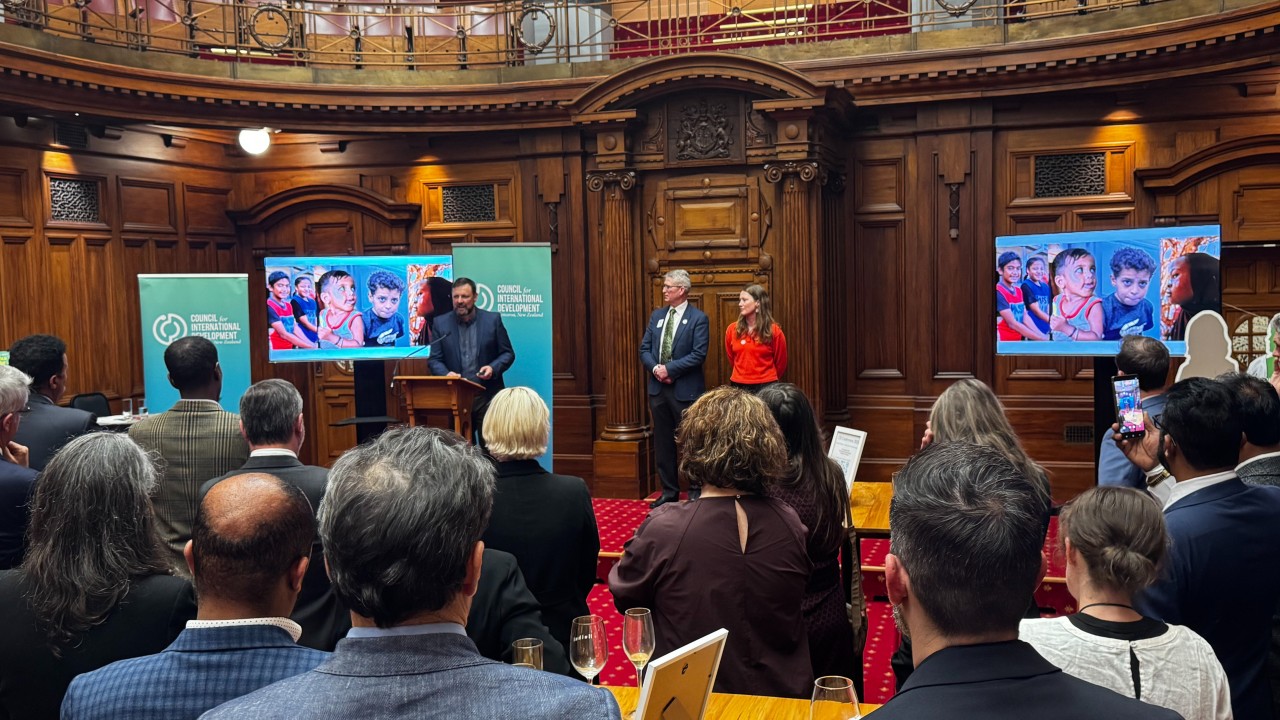
Aotearoa's Humanitarian Community at Parliament for World Humanitarian Day